
What is Cruising, REALLY?
- tonileebeaton
- Aug 28, 2021
- 7 min read

Hi everyone! Thanks for dropping by and checking in. We have been enjoying each and every day here in Bonaire, and the days are flying by. It’s hard to believe we’ve now been living here for 1 month, and we have only 2 months remaining

before heading back North to St. Maarten. It still hasn’t completely sunk in that we live on our boat 100% of the time, but it is feeling more like home every day.
When we first arrived to our mooring ball, I thought for sure we’d do absolutely NO boat maintenance while in Bonaire. I mean, it’s a diver’s paradise! You can literally jump off the back of your boat and be surrounded by the happiest ecosystem of 500+ species of fish. My thoughts: “We aren’t going to be sweating over the teak decks or scrubbing rust away from the fiberglass. We’ll be too busy diving!” Panta Rhei must have heard me and laughed, because she’s given us TONS of jobs to keep us plenty busy! Here are a few of the projects we’ve completed over the last three weeks. We’ve been busy!
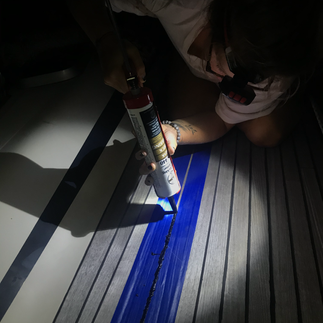
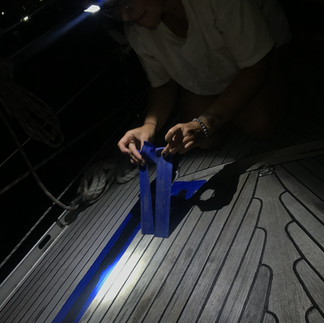
· Teak decks: The NEVER ENDING job! But, we love our teak decks and wouldn’t change them for anything! We’ve completed nearly all of the port side deck, as well as the majority of the forward deck where the anchor locker is. It’s looking really awesome, but we are now at a project standstill as we’ve run out of caulking. We’ll re-supply in St. Maarten where materials for maintenance are way cheaper than here in Bonaire.






· DC fans: I believe I mentioned this is our last blog post, but it deserves repeating. Paul installed and wired 5 DC fans in the cabin and it has made the world of difference, especially as we approach September – pretty much the hottest month of the year in the Caribbean.
· Fridge: We installed a small DC computer fan in our fridge, because our freezer compartment kept icing over. The fridge wasn’t running effectively. Now, the tiny fan keeps the freezer from icing over and we can run the fridge on a much lower setting. Success!


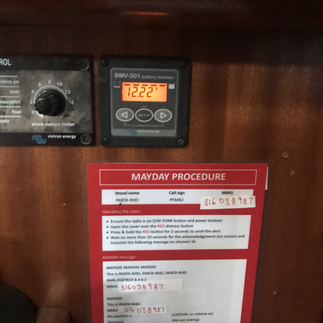
· Battery monitor: We had this ongoing joke that our battery monitor was a liar. It was constantly showing us inaccurate information about the charge and voltage of our batteries, to the point where we just couldn’t trust it anymore. For example, it would display that our batteries were at a charge of 11.80 volts (which is way too low and could permanently damage the batteries); whereas when we checked the voltage manually the batteries were at 13.20 volts. Paul fixed the battery monitor and synced it with the batteries, so we can trust it now!



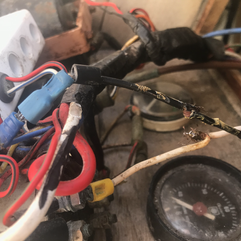
· Alternator: This was a scary one! We had a really rainy day at the beginning of this week. When I say really rainy, I mean tropical downpour all-day-long rainy. Since the only source of electricity we make on the daily is from solar power, we weren’t getting enough to power our fridge (the only thing that draws electricity on our boat 100% of the time). No problem! We decided that we’d run our engine for a few hours to boost our batteries. This is what we had to do every night while sailing from St. Maarten to Curaçao, so that we could run our auto-pilot, navigation, and safety systems while sailing at night – the batteries don’t have the power to last all through the night running those systems. We went to turn on the engine, and… there’s no electricity coming from the alternator. We had 1.1 amps of power before turning on the engine – and 1.1 amps of power after. AHHHHHHHH! Suddenly our ‘back-up’ source of energy is shot, and we now have NOTHING to power our boat. This isn’t catastrophic per say – turn off the batteries, don’t charge anything all day – but, it is incredibly inconvenient. And, no charging of anything (including the fridge) – or night sailing – until this problem is fixed. Long story short, we had the knowledge and advice of many veteran cruisers to help us out. We had many days of trouble-shooting, checking in the manual, tweaking the alternator, with no luck. Our neighbor, Patrick, ended up finding the real cause of the problem. It wasn’t the alternator at all, but the bulb that lights up in the ignition panel when the engine is started. The wiring connection between the lamp and the alternator was busted, so the alternator wasn’t receiving the power to charge. This is not the first time that one teeny bitty wire has been the root of the problem! We had a $500.00 bill in Antigua because our AIS wasn’t working; it ended up being one tiny eroded wire that needed replacing. However, this time around, Paul fixed every wire and bad connection, and voila! Power! This was also the perfect example of how jobs on the to-do list change, as something skyrockets to the top and requires all of our attention immediately!



· Forward hatch: We’ve had some issues of leakage into the forward cabin while sailing longer passages. Not ideal, since the forward cabin has mattresses, clothing, and ALL of our tools! Not a place we want salt water to be. So, we ripped off the forward hatch, scraped and cleaned all of the old foam connecting it to the fiberglass, and re-sealed the hatch with marine grade caulking. It’s in the drying process now, and fingers crossed it’ll keep the salt water out on our way back to St. Maarten.
· V berth: This is a project we actually started way back in Curaçao that’s taken a lot longer than expected. It’s also one of those jobs that keeps being put on the back burner, as more important jobs come up as things inevitably break. Between the fiberglass hull and the ceiling upholstery, there used to be a solid piece of black foam insulation. Over the decades, this insulation has eroded into this fine black powder and the ceiling fabric started to sag from the weight of the disintegrating foam. The fabric started to tear, and then the black insulation started pouring out of the fabric – gross and itchy! So, we ripped out all of the ceiling upholstery, vacuumed and scrubbed out the insulation from the fiberglass, sanded down the three pieces of wood (headliners), and bought new fabric to re-upholster the wooden pieces. Before all this happened, we also had to unscrew every single piece of ‘finishing’ wood around the cupboards and headliner. I wish I had taken “before” pictures because it was so disgusting, but you’ll have to take my word for how bad it was getting. It looks incredible now! The same issue is happening in the two aft cabins, but not to so much of an extent (since the forward cabin has a huge hatch and the majority of the airflow, the fabric started falling apart much quicker). I don’t know if we’ll be tackling the two aft cabins anytime soon – it was a dirty job – but now we have a bit more know-how of what we’re getting ourselves into.


We’ve also had time to explore four of Bonaire’s dive sites with scuba tanks, and many more freediving and snorkeling. Our balance has been a little off kilter the last few weeks – more on the maintenance side – but better to be proactive now than full of regrets later!
We’ll leave you with the biggest lessons we’ve learned (so far) living on a boat:
Paul:
· A stitch in time saves nine: Something that could cost you 10 minutes in the moment could end up costing you a few hours and hundreds or thousands of dollars if you let it sit. Fix it, fix it! This is an old saying, but how true it is!
· There is a way longer list of wants than needs: What you actually need to get

by on a boat, versus what you want, is quite different. It really is akin to camping (or glamping if you like that better).
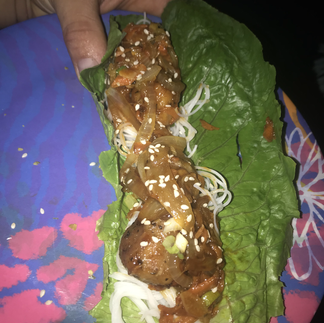
· Cooking: There’s an opportunity to make so many different kinds of meals. Whether it’s inspired from the ocean (fresh fried lionfish) or from fellow cruisers (vegan sun-dried tomatoes and mint lentils), we’ve tried cooking tons of new meals. Cooking dinner is one of our favorite parts of the day.








Toni:
· Don’t be too hasty: This is a difficult one for me, because I’m such a proactive planner! But I’ve come to find that on the boat, it’s better not to be too hasty or jump to conclusions, especially in two areas – planning for upcoming trips, and looking into local island rules and regulations. There’s been times that we’ve spent a lot of money preparing something for a particular island, and then we end up not even needing it.
· Cruising community: This is something we had an inkling of while living in St. Maarten, but we didn’t really come to know it until we were proper cruisers

ourselves. There is such a strong, welcoming community of cruisers in each destination we’ve been. Cruisers will not hesitate to help each other in any way at any time, with no ulterior motives or expectation of being paid back. Cruisers will welcome you with open arms; no ‘cliques’ to be found here (unless ‘cruisers’ themselves can be a clique!)
· Boat maintenance: Alright, I knew we were going to have maintenance to do on the boat... but not quite as much as we are ending up doing! Here is a favorite saying of cruisers: “Cruising is fixing your boat in exotic locations.” I really did not know how true this is! We have days and days going by that we are only doing maintenance. It seems like an exaggeration, but it really does just eat up the entire day. However, I’d rather be doing maintenance on the boat in small chunks every day, versus leaving things to degenerate and having a really big problem down the road. There’s also a sense of accomplishment every time we achieve a new boat chore or acquire a new bit of knowledge.
Thanks for sticking with us! We will continue updating on our liveaboard

adventures in Bonaire, and will have an upcoming post with lots of underwater footage from our dives and snorkeling.
Sending lots of love from our part of the world to you!
Toni & Paul


Comments