
A Crew for the Ages!
- tonileebeaton
- Dec 13, 2021
- 7 min read

Hi friends and fam! First off, our apologies for not posting in such a long time. It

has been an absolute blast being back in St. Maarten, but it’s also been one heck of a whirlwind!
We’ve been so fortunate to be able to spend a good chunk of time catching up with old friends while visiting SXM. Lots of great conversation, hikes, sailing trips, beach time, and home cooked meals have definitely ‘filled our buckets,’ so to speak! Sending lots of love and a big thank-you to those who have made our time so special.


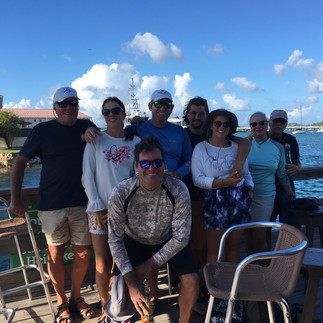




A very exciting development while spending time in SXM is that we have had our first visitors on Panta Rhei! Paul’s mom, Anna, and stepdad, Steve, spent 2 weeks with us on the boat. It was a huge treat having family with us to experience boat life, and we must say that they were THE best crew we’ve ever had!


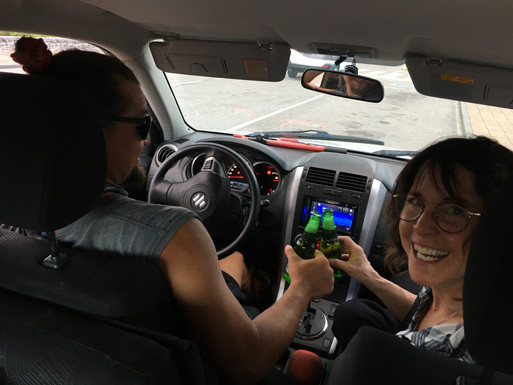


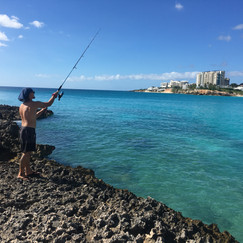


Anna arrived about 5 days before Steve, as she left from Canada and Steve from Mexico. For several days before Anna’s arrival, St. Maarten had been hit with quite the windy burst of weather. Fortunately, that passed a day after she landed on SXM… just in time to set sail! Myself and Paul took Anna and our great friend Sabz for a 3-day sailing trip around the island… literally… we circumnavigated St. Maarten! On our first day, we left the Simpson Bay Bridge at 8:30 AM and headed east around the southeast corner of the Dutch side of the island. We then turned north-northeast towards the French side, the island of Tintamarre being our

destination. After a solid 7 hours of sailing in some of the most demanding conditions we’ve sailed in, we arrived at Tintamarre safe and sound. We spent the night on a mooring and awoke to a beautiful sunrise and a secluded beach.
The next morning as charter boats started to pour in to Tintamarre, we took the opportunity to move onwards in our trip. A short 2-hour sail brought us around the northernmost tip of the island and around the west / leeward coast to Creole Rock, a protected area on the French side near the bay of Grand Case. We

again attached to a mooring and enjoyed crystal clear water for swimming – and scrubbing the boat’s waterline, which was starting to grow an algae beard! Dinner that evening consisted of the popular rib platters at the LOLO (Locally Owned Locally Operated) beachfront restaurants. A platter of ribs, rice and beans, coleslaw, potato salad, and salad, for $10.00. Can’t beat that! A gorgeous full moon greeted us back on the boat, and we all slept soundly after a lot of fun in the sun.





Our third day brought us south-southeast around the leeward side of the island as we headed back for Simpson Bay. We sailed for about 5 hours and enjoyed a BBQ lunch of smokies en route. Really favorable winds enabled us to have full main and full headsail out the entire day. It was one of the best sailing weekends we’ve ever had on St. Maarten.

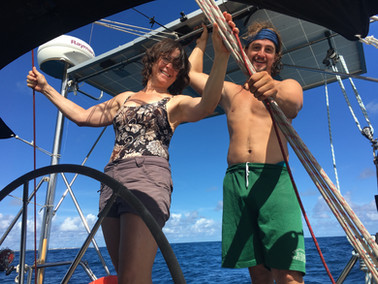

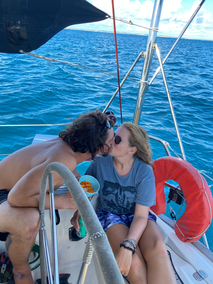


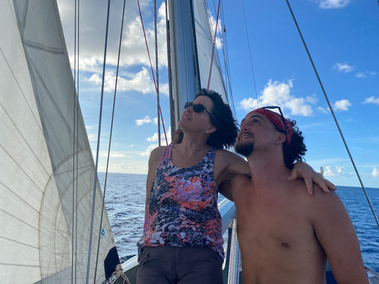
While Anna and Steve were visiting, we hit up our favorite restaurants, including Chinese food at Yami Sushi, Japanese at Naruto, and Indian food at Lal’s, and visited some of our favorite beaches, including Mullet Bay Beach and Pinel Island. They were also invaluable crew members, and so flexible and willing to help with any and all projects that were on our never-ending to-do list. Here’s a couple of projects we checked off with the help of our two newest crew members:
Transom Shower: We have a 2-meter hose and showerhead off the back of our boat on the transom, with a freshwater supply. It’s super convenient to quickly rinse off the saltwater after a dip in the ocean, but the showerhead was busted so

that water just continuously free flowed, garden-hose style. We replaced the old hose, fixed a small leak, and replaced the showerhead with a new trigger-operated one that is much more useful! We had a small learning curve with this
newfangled showerhead though… as we awoke one morning to find that our newly filled 240L freshwater tank had ENTIRELY drained into the lagoon over the night. A rope from our tied-off dinghy got stuck underneath the nozzle, and flicked up the handle for the new showerhead. Hopefully the fish enjoyed the freshwater!! Now we know to either close off the tap before bed, or to turn off the water pump. Lesson learned.
Windlass: Thankfully, this was a quickly fixed problem to a very problematic situation! A windlass is a battery-powered (or manual, if you’re tough as nails)

device that helps to raise or lower one’s anchor. Unfortunately for us, our windlass decided to stop working. Not the hugest of deals when lowering the anchor, but when it’s time to go, Paul is lifting a 25kg anchor and at least that much weight of chain by hand back into the boat. It was a quick fix though, as there was a bad wiring connection on ‘neutral’. As Paul would say, “Curse you, yellow-tape, black-wire guy!” It seems that any time we find an electrical problem, the wiring was rigged in a very cumbersome way by the same person who consistently used the same materials. Now our windlass is fulling functioning, so dropping and lifting the anchor is a breeze!
Traveller Rope Clutches: Our port-side traveller rope clutch had seen better days. It was obviously broken and repaired since we originally purchased PR, and it finally bit the dust. We tried to baby it for as long as possible, but it became clear that it started to be a safety concern when we couldn’t properly release the traveller to adjust the mainsail. We purchased new rope clutches from Budget Marine and installed them beside the rest of our halyard clutches. They’re super easy to use, and look very sleek to boot!


Dinghy: Our dinghy got a lot of love since being back in St. Maarten. We had the chaps (the protective fabric covering the PVC material that makes up the dinghy’s pontoons) resown, and we fixed a broken handle. We also installed a navigational solar light on the outboard engine as a safety precaution when using the dinghy at night. Additionally, we had the ‘kill switch’ replaced. Back in Curaçao, we had a small issue with a stern anchor line. As our boat moved, the stern line tightened, and our dinghy’s engine got caught underneath the tightening line. The line ripped off our kill switch, and even though Paul was able to reattach it, it wasn’t exactly the safest of kill switches… usually, a kill cord (red plastic bungee cord) is put into the switch in order for the dinghy to start. Then, to turn the dinghy off, the kill cord is simply removed. The logic is that you have the kill cord attached to your person while driving the dinghy, so if you happen to fall out, the engine will stop. Our dinghy would start without this cord, and to stop it we had to actually push in the kill switch! Now it’s all replaced and back to normal safety standards (yay!) “Jefe” (the Highfield) looks much happier now!
Holding Tank: Alright, get ready for a story, or feel free to skip ahead. Our boat was built in 1991, and was not manufactured with any type of holding tank. A holding tank is usually installed in a boat’s head (bathroom), and it does exactly what it says. If you are cruising or sailing in an area where it is illegal to dump blackwater waste into the water (such as the United States or Canada), a holding tank holds waste until it is able to be expelled into the water – either 5 nautical miles away from the borders of the US or Canada, for example, or at a marina where they can pump out one’s holding tank directly from the deck. Since we are planning to sail to the US Virgin Islands and Puerto Rico – both under the jurisdiction of the United States – we needed to install a holding tank for legality and environmental purposes. So, we purchased all the necessary materials (and there are A LOT of materials) and were ready to get started. Unfortunately, the seacock (a ball joint connected to a through hull, which sandwiches the inside and outside of the boat) connected to the toilet was seized in the ‘open’ position. Not a huge deal for our current situation, but if we needed to install a holding tank, that seacock MUST be able to close. This isn’t something to mess around with or change while the boat is in the water, in our opinion, so we needed to haul our big baby out of the water to deal with the repairs. We had our boat lifted in slings and were able to change out the faulty seacock, as well as drill a new hole in the boat to make the installation of the holding tank more simplified. It was nice to get all the barnacles off the hull in the meantime as well, even though seeing PR out of the water gave me a small heart attack! We also gave some love and attention to spots where the anti-fouling had worn through from rope chafe. We sanded, used an epoxy primer, and applied antifouling paint to those patchy areas to help the current antifouling paint last a bit longer. After all of this, we are now finally good to go and can legally take our boat into any US or Canadian territorial waters. It also increases the value of our boat to have a holding tank installed for future buyers, if it comes to that. Oof, what a job! Happy to have this one off the list!





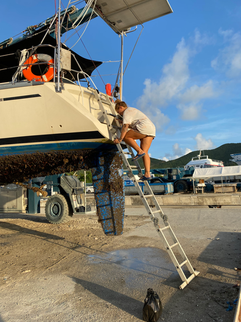


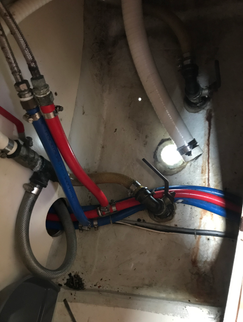













We couldn't have gotten through these tasks without our awesome crew members. We were so happy hosting Anna and Steve, and so thankful for the time we got to spend together!




Having completed these tasks, we felt like it was time to reward ourselves and continue with the cruising lifestyle. What better way to celebrate than to visit a new island?! Well, that’s exactly what we did! Stay tuned for our next blog post where we share our experience sailing to the very chic, the very popular, for the very rich and famous… the island of St. Barth’s!
XO
Toni & Paul


Comments